ROBOTICS · AN EXPERIMENT JOURNAL
LeRobot Pi0.5 ACP
A journal of the Pi0.5 reinforcement-learning workflow. From human intervention and value learning to advantage-conditioned training, documenting every attempt—including those that did not improve the policy.
Explore the journey ↗THE LATEST CHAPTER
Training complete.
Real-world testing next.
STATUS AS OF OCTOBER 15, 2026
R3-v2 has completed 9,000 corrective training steps, with candidates saved at 3K, 6K, and 9K. Real-robot performance remains untested; the original B0 remains the production baseline.
Read the latest experiment ↗Round 1 HIL dataset
Three-policy evaluation episodes
R3-v2 successful trajectory pool
R3-v2 corrective training
01 / THE JOURNEY
How the experiment evolved
Question → Experiment → Result → Next step
Trace each experiment and the decisions it informed.
Entries follow the stage order of the experiment. Stage numbers identify the workflow, not calendar dates.
02 / REAL-WORLD EVALUATION
Results before expectations.
Real-robot trials under fixed conditions.
Evaluation batches are kept separate.
Round 2 · Fixed-matrix evaluation of three policies
Each policy ran 81 episodes: 243 complete dual-camera episodes in total. R2 exceeded R1 by 7.4 percentage points but remained 9.9 points below B0.
| Policy | Success | Not picked | Not placed | Wrong color | Success rate |
|---|---|---|---|---|---|
| B0 original policy | 63 | 16 | 0 | 2 | 77.8% |
| ACP R1 | 49 | 29 | 2 | 1 | 60.5% |
| ACP R2 | 55 | 15 | 10 | 1 | 67.9% |
03 / LEARNING FROM FAILURE
Lifting is only
the first test.
R2 reduced missed picks but produced 10 failed placements. Frame-by-frame review of both cameras identified weak grasp establishment as the main failure mode, rather than final release.
The remaining cases were one transport drop and one timeout. All 10 annotations were high confidence.
An independent R3 correction dataset followed. The first R3 policy achieved only 12/75 across screening and extended checks and was not released. R3-v2 then used a balanced pool of successful trajectories.
04 / FIELD NOTES
Evidence from the process
Select an image to enlarge
From collection to execution
Four frames from the paper’s Section 8.3. External recordings document the experimental procedure; they are not policy inputs.
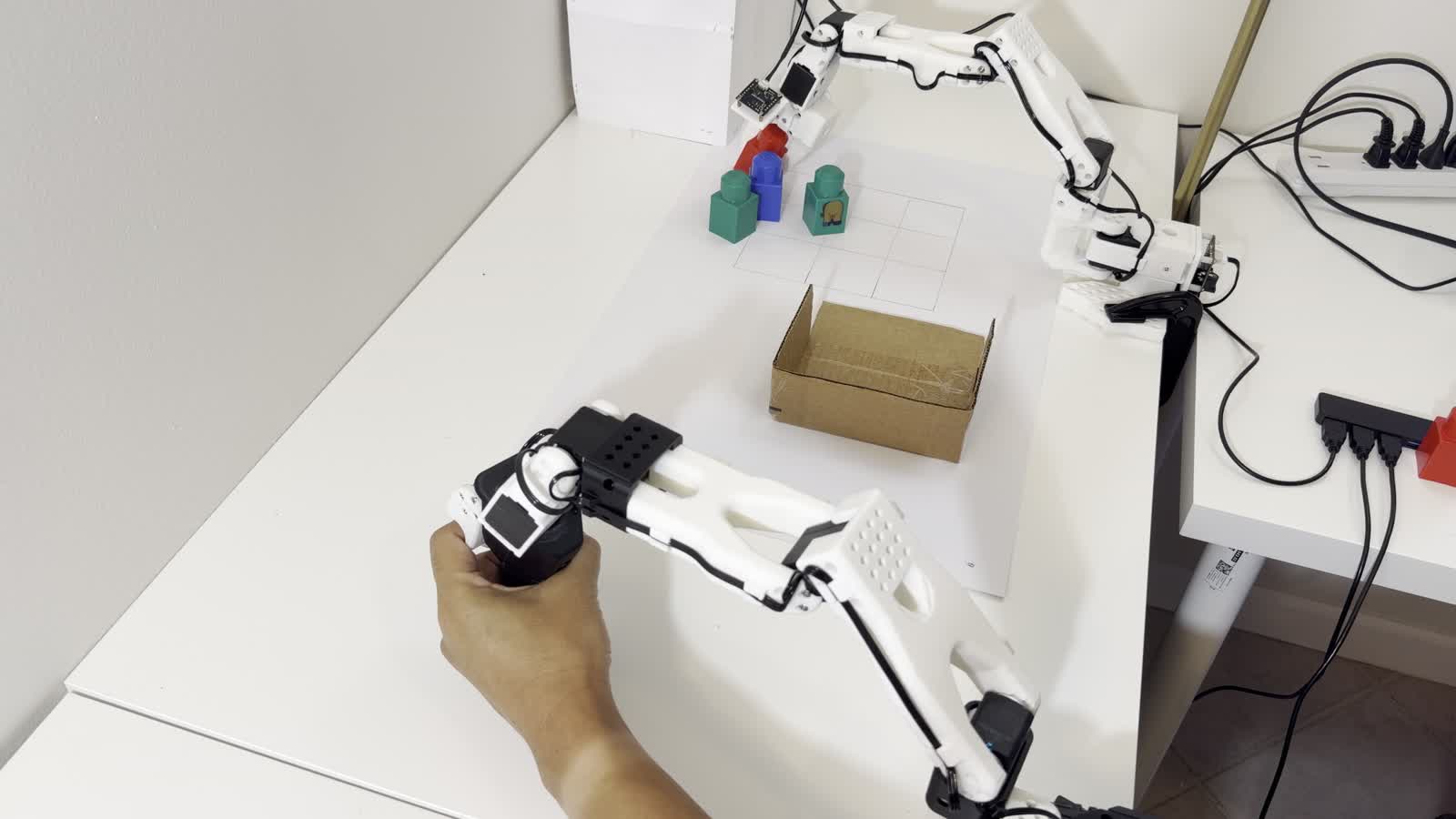
The operator controls the leader arm while the follower executes.
IMG_2800.MOV · 01:15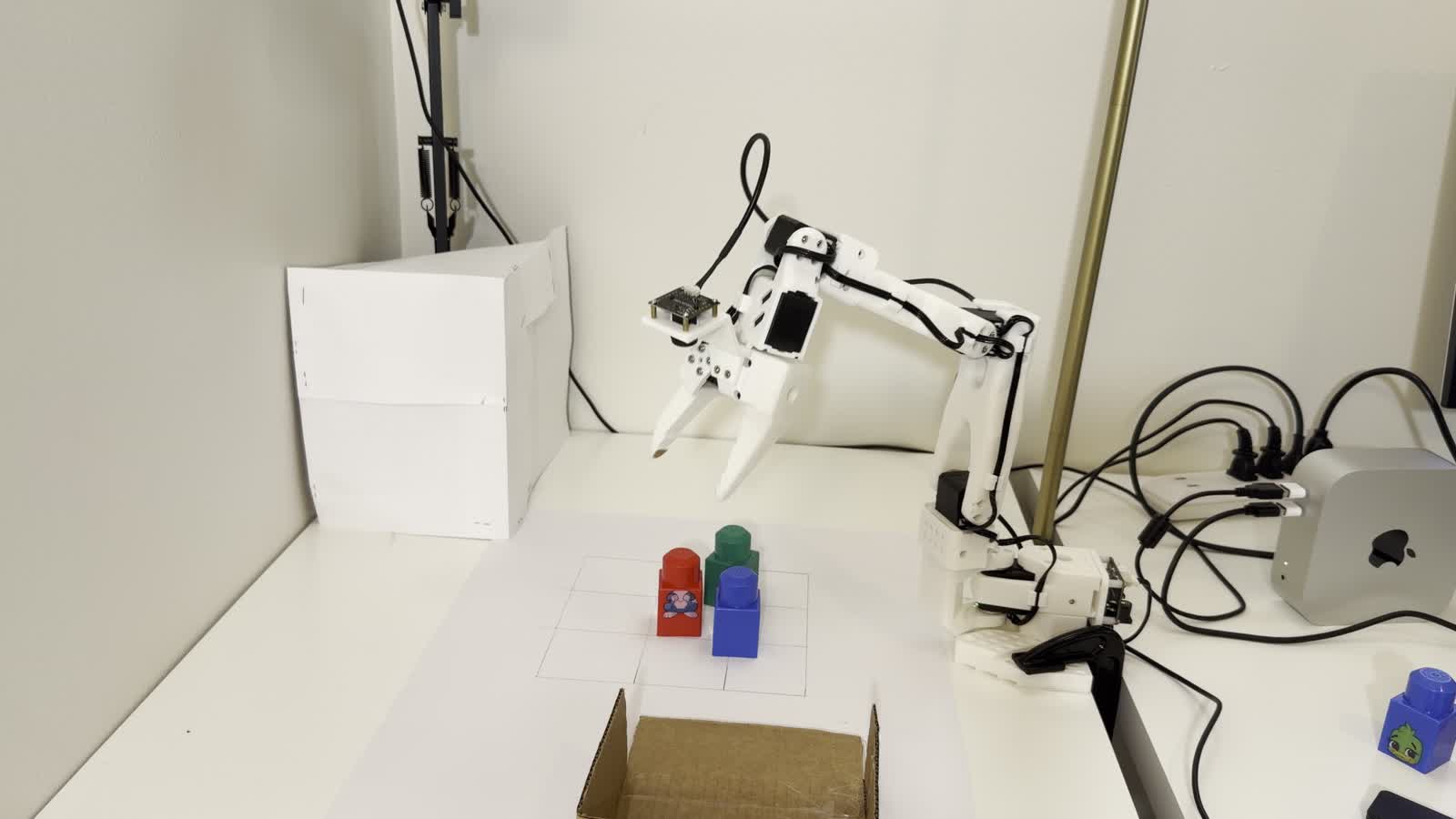
The policy approaches the target block without human control.
IMG_2775.MOV · 00:30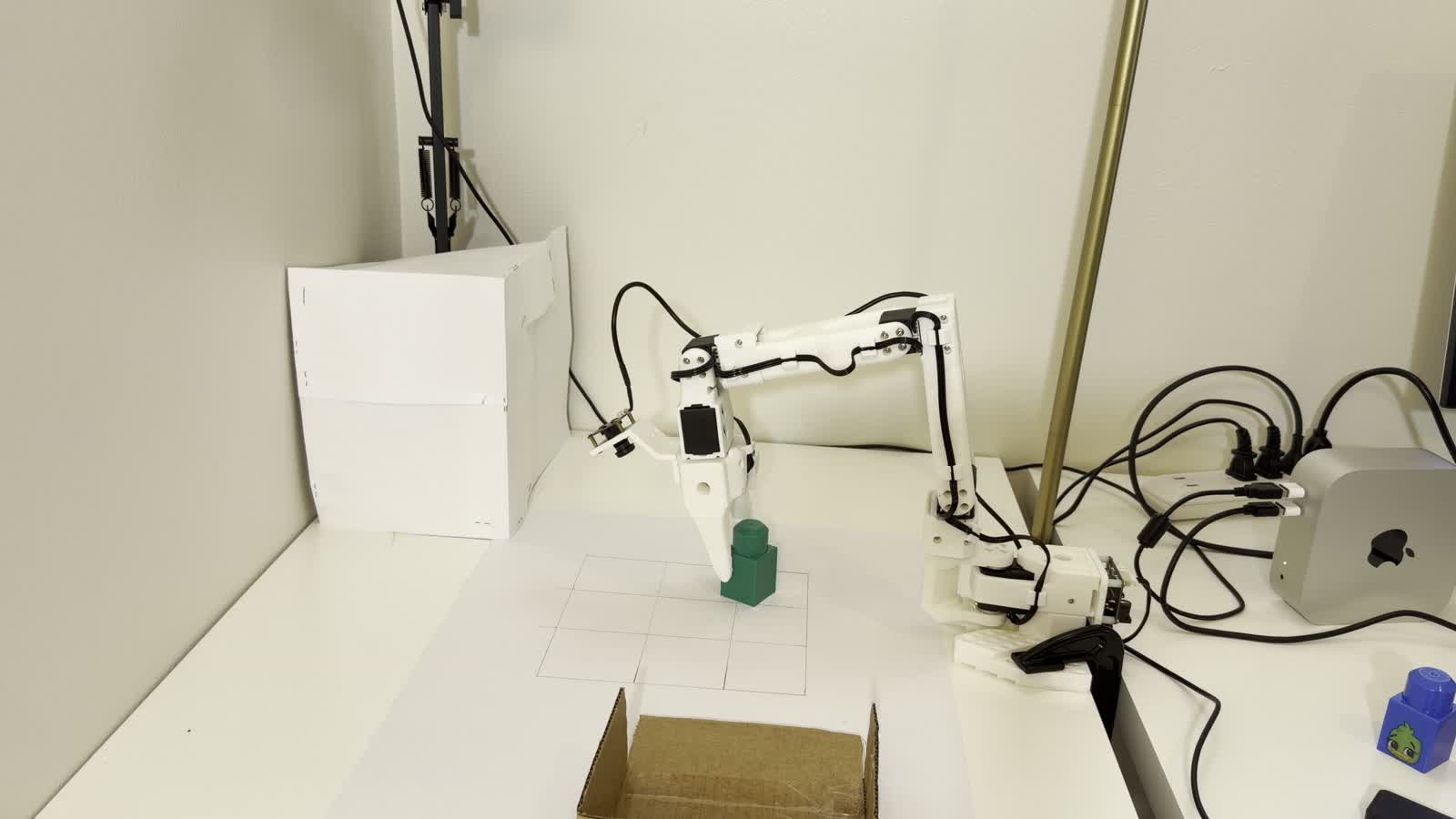
The target block has been placed in the box.
IMG_2775.MOV · 02:30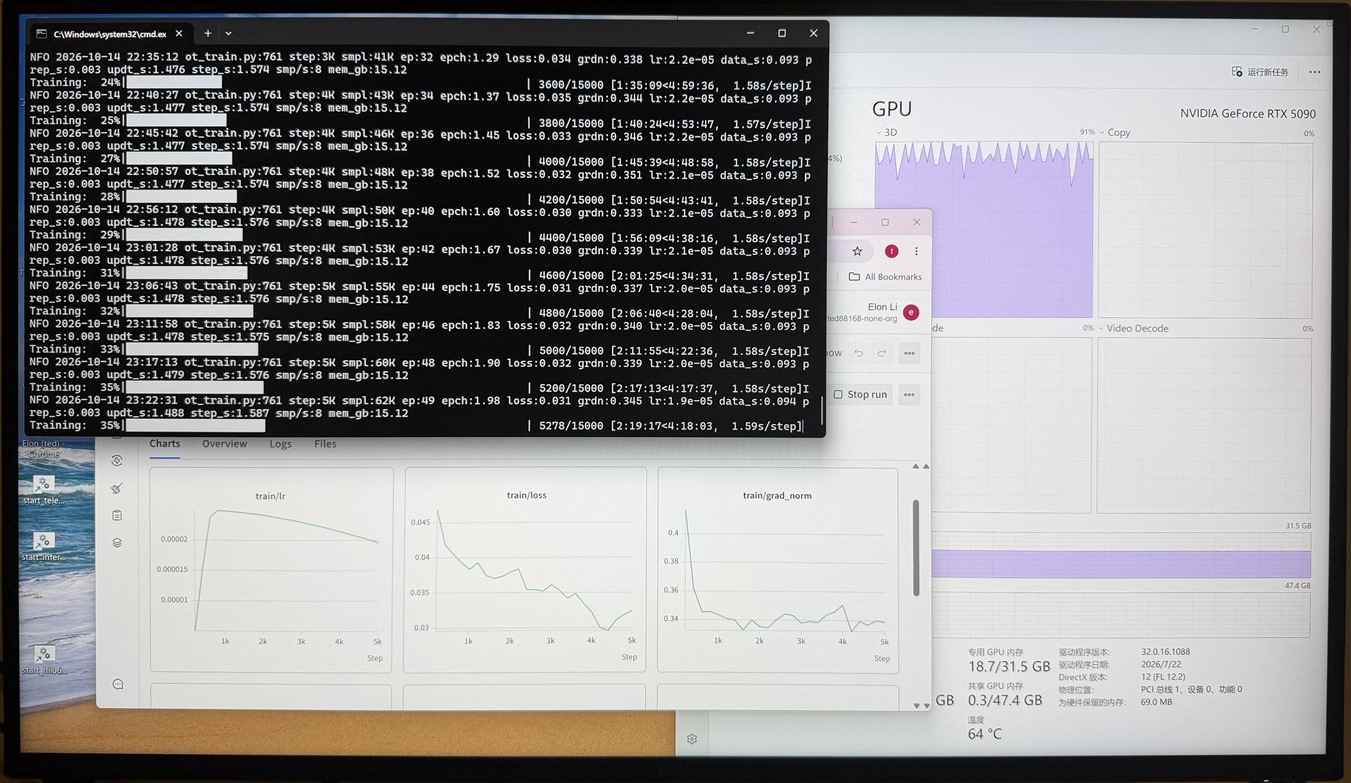
Terminal logs, W&B curves, and RTX 5090 utilization during training.
IMG_2937.jpgOptimization traces document training; lower loss does not establish real-robot improvement.
Completed stages, corrective iterations, and the pending evaluation gate.
The workcell, failure diagnosis, training curves, and workflow can all be enlarged.
THE NEXT EXPERIMENT
Same conditions. New comparison.
Stage 13 will compare R2 15K with R3-v2 at 3K, 6K, and 9K. The task matrix, starting pose, reset rules, and camera conditions will be held fixed. Metrics cover first-grasp stability, transport drops, final placement, wrong-color picks, and reset consistency.
This evaluation was pending at the recorded status. R2 is the comparison reference; B0 remains the production baseline. Completed training alone does not qualify a candidate for promotion.
05 / REPRODUCE & TRACE
Trace the experiment
Windows · SO-101 · Dual cameras
LeRobot 0.6.2 · RTX 5090 32GB
Method scope and data rules +
The workflow draws on value models, advantage labeling, and ACP conditioning, with human intervention, fixed-matrix real-robot evaluation, and failure review. It is not a full reproduction of π*0.6. Continuous autonomous rollout and a fully automated multi-round loop have not been implemented.
Frozen evaluation episodes do not enter training for the same round. R3 correction data were collected independently; the R3-v2 policy pool contains successful trajectories only. Raw datasets remain frozen, with new labels written to copies.
Data and training snapshots +
- Round 1: 120 episodes / 137,200 frames; revision
b361a8f9d952cc082dc3f6d0a195ca05a24435e0 - Round 2 combined pool: 204 episodes / 239,093 frames; revision
6bd6aee1df33cdfb1dbc01d4ca708756331e6073 - R3: 25 episodes / 31,527 frames; revision
d576d5885dd38b521c34050f4ecdb3ee230cca74 - R3-v2: 64 episodes / 64,531 frames; a unified indicator field with 35.86% positive labels; initialized from R2 15K.
GitHub & Hugging Face +
Project code, training datasets, and model checkpoints.